
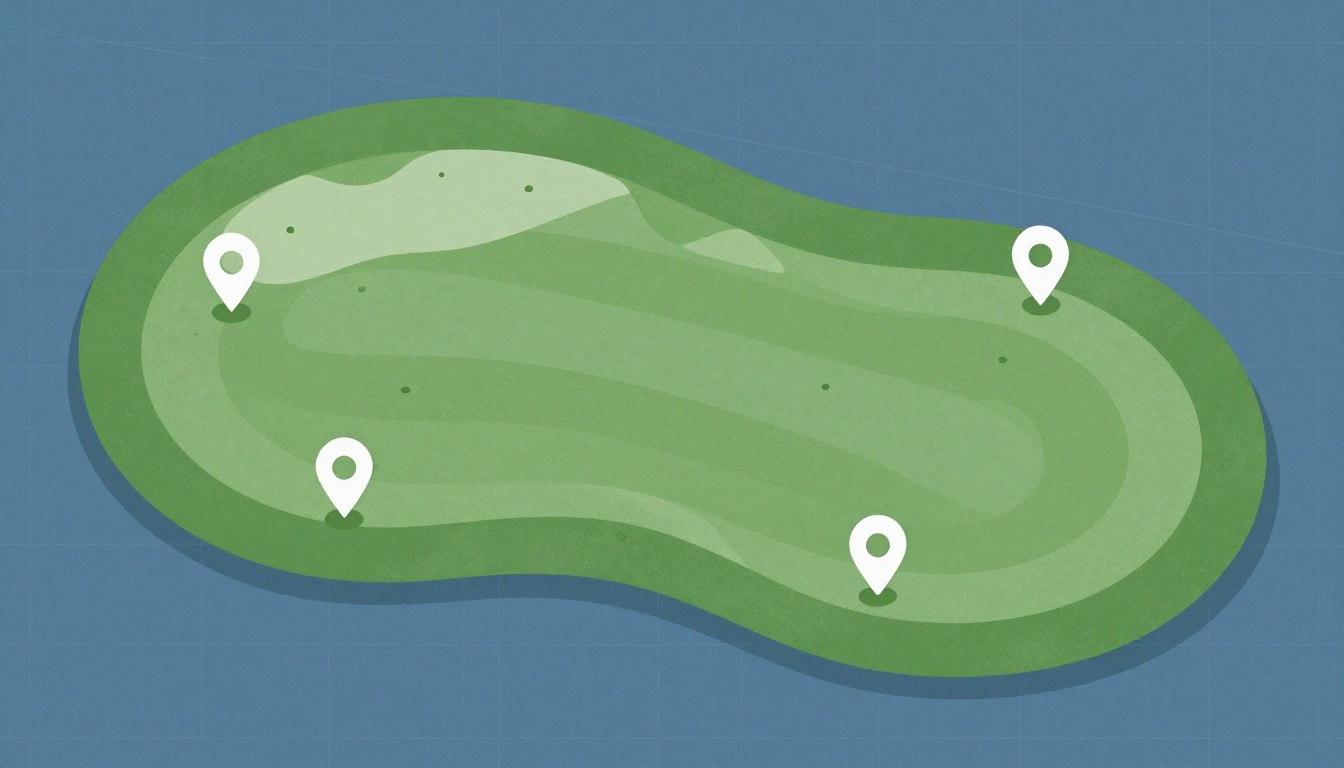
When you're building a golf app, the geocoding API you choose determines whether your users see accurate pin positions or frustratingly misplaced greens. Generic geocoders often fail on golf courses because they rely on address points or street interpolation, which can place a course entrance miles from the first tee. Golf-specific APIs solve this by returning hole polygons, tee coordinates, and hazard layers—data you can't get from a standard address geocoder.
In this guide, we compare five golf course mapping APIs based on coverage, accuracy, pricing, and licensing. We'll help you match each one to your project's scale, budget, and geographic focus.
Which golf course mapping API offers the largest global database with over 40,000 courses in 160+ countries?
Select one answer.
What to Look for in a Golf Course Geocoding API
Before diving into the options, understand the key evaluation criteria. A geocoding API should be easy to set up, deliver rooftop-accurate geocodes, be transparent about accuracy, and allow you to store results in perpetuity (Hacker News discussion). For golf, you also need:
- Hole-level data: Polygons for greens, fairways, and hazards, not just a single course coordinate.
- Coverage: Does it include the courses your users play? US-only vs. global matters.
- Pricing model: Free tiers, per-request costs, or subscription—match to your expected volume.
- Licensing: Can you cache and resyndicate the data? Some APIs restrict storage, which limits long-term use.
Accuracy is especially tricky for golf courses. Physical mapping methods are accurate but time-consuming and can become outdated (Shot Scope). Incomplete address data and poor address points are common geocoding challenges (LightBox). A golf-specific API should have already solved these issues with dedicated course surveys.
The Five Golf Course Mapping APIs
1. GolfLogix
GolfLogix offers over 40,000 mapped courses worldwide, with precise front, center, and back green locations, plus detailed fairway and hazard mapping. Their API includes advanced terrain and 3D visualization data, ideal for immersive simulators. Licensing is enterprise-oriented, so it's not the cheapest starting point, but data quality is top-tier for serious apps.
2. Golfbert
Golfbert is a developer-focused geodata API for building golf course maps with optimized data on greens, fairways, and hazards. It covers thousands of US courses and returns detailed hole polygons and vector coordinates. You can fetch all holes for a course or specific polygon data for a single hole, making it easy to render interactive maps. Documentation is clear, and pricing plans are straightforward. If you're building for the US market, Golfbert gives you the raw data you need without fluff—a solid middle ground between free APIs and enterprise giants.
3. GolfCourseAPI
GolfCourseAPI is the only completely free-to-try golf course API, offering access to nearly 30,000 courses worldwide. Sign up with just an email and start making requests immediately. The free tier allows up to 50 requests per day, perfect for hobby projects. For production, the Pro plan at $9.99 per month gives you 10,000 requests daily, and Enterprise goes up to 100,000. They also have a course editor for Pro and Enterprise users to update data themselves. Great for getting started without a big upfront investment.
4. Golf Intelligence
Golf Intelligence brings 20 years of proprietary course data, with daily updates from around the world. Their database includes location, layouts, GPS data, and multi-tee scorecards. They also offer weather forecasts and climate trends—a unique addition. Pricing is credit-based, with a $49 test pack for 50 credits, and full course details cost 3 credits each. This might be pricier for heavy usage, but data accuracy is impressive. If you need precise mapping for a simulator or high-end app, consider it.
5. Golf API
Golf API boasts the largest database with over 40,000 courses in 160+ countries. They offer a REST API and full database export in CSV format, handy if you want to import data directly into your own system. This is a good choice for global coverage and bulk data needs.
How to Choose: A Practical Checklist
- Define your coverage needs: US-only? Global? Check the API's course count and geographic focus.
- Assess data depth: Do you need hole polygons, hazards, or just course locations? Match to your app's features.
- Calculate costs: Estimate your monthly API calls. Free tiers are great for prototyping, but production costs add up.
- Review licensing: Ensure you can store and use the data long-term. Some APIs restrict caching or resyndication.
- Test integration: Use the API's documentation and sample code to see how quickly you can render a course map.
Quiz: Test Your Knowledge
Which golf course mapping API offers the largest global database with over 40,000 courses in 160+ countries?
- GolfLogix
- Golfbert
- Golf API
How the Featured Expert Can Help
Golfbert provides a geodata API for building golf course maps, offering detailed hole information and interactive features for developers. The site focuses on API access, documentation, and pricing plans for use in golf-related applications. If you're building a golf app for the US market, explore Golfbert to see how their API can streamline your development.